

“Passive income” is one of the most misunderstood phrases in online business.
People imagine money coming in while they sleep — with no systems, no planning, and no structure.
In reality, passive income isn’t about doing nothing.
It’s about building systems that work without constant manual effort.
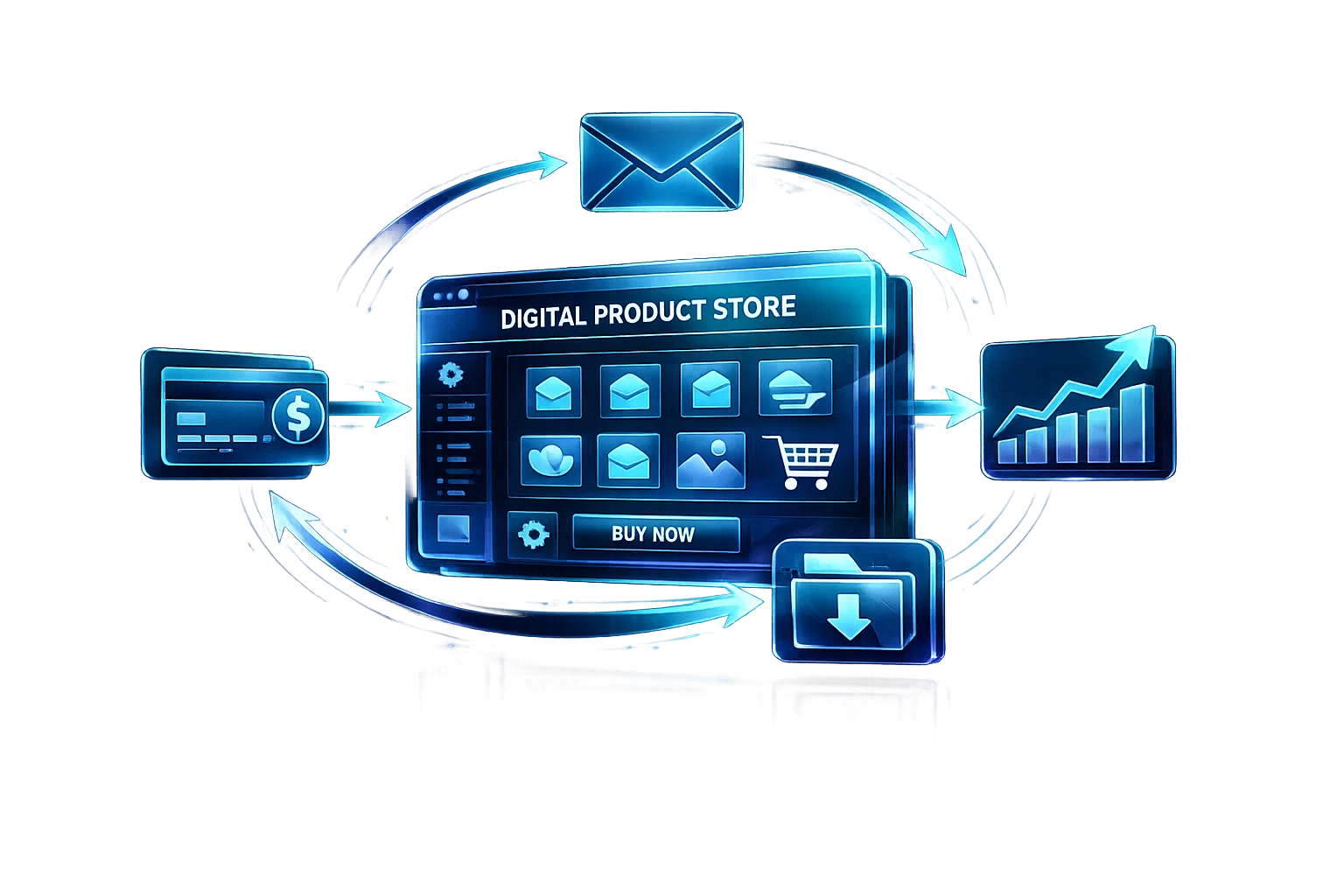
And one of the most powerful systems you can build today is an automated digital product store.
If structured correctly, your store can:
- Accept payments automatically
- Deliver products instantly
- Trigger email sequences
- Upsell additional offers
- Collect customer data
- Run globally 24/7
All without you manually sending a single file.
In this guide, we’ll break down exactly how to automate a digital product store for scalable, low-maintenance income.
Step 1: Start with the Right Infrastructure
Automation doesn’t start with tools.
It starts with structure.
Your digital product store must include:
✔ Secure payment gateway
✔ Automated product delivery
✔ Email system integration
✔ Conversion-optimized checkout
✔ Mobile responsiveness
Without this foundation, automation becomes patchwork.
Many beginners attempt to automate a poorly structured store — and end up fixing errors instead of scaling.
If your backend isn’t solid, your automation will break under growth.
Step 2: Integrate Secure Global Payments
Automation begins the moment someone clicks “Buy.”
Your payment system should:
- Accept global transactions
- Process instantly
- Trigger automated workflows
- Confirm payment in real time
Common options include Stripe, PayPal, and other secure global processors.
But integration alone is not enough.
The payment event must connect directly to:
- Product delivery
- Confirmation emails
- Customer account creation
- Email automation sequences
That connection is what turns a simple store into a system.
Step 3: Automate Digital Product Delivery
This is where passive income truly begins.
Instead of:
- Manually emailing files
- Sending download links
- Responding to every purchase
Your system should:
- Confirm payment
- Generate secure download link
- Deliver product instantly
- Send confirmation email
- Log customer data
All within seconds.
Proper automation improves:
- Customer trust
- Professionalism
- Time efficiency
Instant delivery increases satisfaction — and reduces refund risk.
Step 4: Connect Email Automation
Email is one of the most important automation layers.
When a customer buys, your system should automatically:
- Add them to a segmented list
- Send welcome email
- Provide onboarding guidance
- Offer related products
- Trigger upsells or bundles
Email automation turns one sale into a long-term relationship.
Without it, you leave revenue on the table.
Even basic sequences can significantly increase lifetime value.
Step 5: Add a Simple Sales Funnel
Automation becomes more powerful when combined with structured funnels.
A basic automated funnel may include:
- Product page
- Checkout
- Upsell page
- Thank-you page
- Follow-up emails
Advanced automation can include:
- Downsell offers
- Limited-time bonuses
- Behavioral email triggers
The key is not complexity.
The key is sequence.
Sequence creates momentum.
Step 6: Optimize for Conversion
Automation alone doesn’t guarantee income.
Your store must convert visitors.
This includes:
- Clean layout
- Clear value proposition
- Simple pricing
- Professional branding
- Strong call-to-action
A poorly designed store with automation still won’t perform.
Professional structure increases trust — and trust increases conversion.
That’s why many serious founders prefer infrastructure built correctly from day one instead of fixing mistakes later.
You can explore structured infrastructure options here:
👉 https://digitalsellify.com/services/
Step 7: Scale Traffic, Not Workload
Once automation is active, your focus shifts to growth.
Instead of managing delivery, you focus on:
- SEO content
- Social media traffic
- Paid advertising
- Partnerships
- Email list growth
Automation handles operations.
You handle expansion.
That’s the difference between active work and leveraged systems.
What Makes a Digital Store Truly Passive?
Let’s be realistic.
No online business is 100% passive.
But a properly automated digital product store minimizes manual work by:
✔ Eliminating physical logistics
✔ Removing manual delivery
✔ Reducing technical support
✔ Automating communication
✔ Structuring customer journeys
When everything is connected properly, the business runs continuously.
And that’s scalable.
Common Automation Mistakes
❌ Overcomplicating Systems
Beginners often try to integrate too many tools.
More tools = more failure points.
Start simple. Scale strategically.
❌ Ignoring Mobile Optimization
Most traffic is mobile.
If your automation works perfectly but your store looks broken on mobile, conversion drops.
❌ Skipping Testing
Before launch:
- Test checkout
- Test delivery
- Test email triggers
- Test upsells
Automation must be verified.
Is Automation Enough for Passive Income?
Automation is infrastructure.
Income still depends on:
- Product-market fit
- Traffic
- Positioning
- Marketing consistency
Automation removes friction.
Marketing creates revenue.
When both align, you get sustainable growth.
Why Many Entrepreneurs Choose Done-for-You Infrastructure
Setting up automation manually requires:
- Technical understanding
- Plugin integration
- Workflow logic
- Funnel design
- Testing cycles
Many founders prefer investing in structured infrastructure so they can focus on growth.
If you want to compare structured options:
👉 https://digitalsellify.com/pricing/
Or request a custom setup:
👉 https://digitalsellify.com/get-a-quote/
Final Thoughts
Automating a digital product store is not about shortcuts.
It’s about systems.
When your payment, delivery, email, and funnel work together seamlessly, your store becomes an asset — not a daily task.
That’s how you move from:
Manual effort → Structured automation
Inconsistent sales → Scalable systems
Overwhelm → Clarity
Passive income isn’t magic.
It’s engineered.