
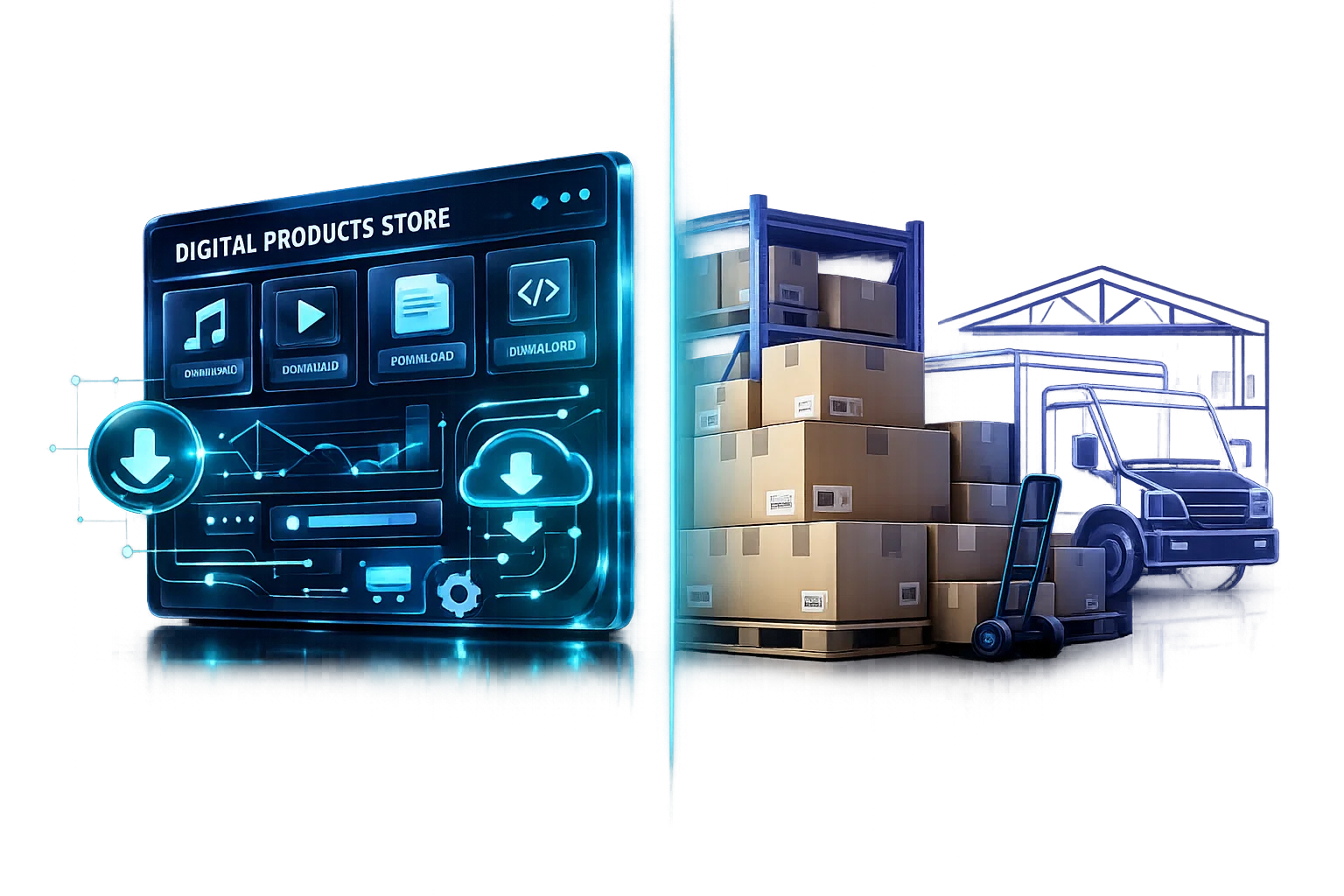

If you’re planning to start an online business, you’ve probably asked this question:
Should I build a digital product store or start a traditional ecommerce business?
Both models can generate revenue.
Both can scale.
Both require marketing.
But they operate very differently.
Understanding those differences can save you months of trial, error, and frustration.
In this detailed comparison, we’ll break down:
- Startup costs
- Operational complexity
- Profit margins
- Scalability
- Automation
- Risk
- Long-term sustainability
Let’s analyze both models honestly.
What Is a Digital Product Store?
A digital product store sells downloadable products such as:
- Ebooks
- Templates
- Courses
- Planners
- Toolkits
- Software files
- Digital resources
Once created or licensed, digital products can be sold unlimited times.
Delivery is instant.
There is no physical handling.
Automation is the backbone of this model.
What Is Traditional Ecommerce?
Traditional ecommerce involves selling physical products like:
- Apparel
- Electronics
- Beauty products
- Home goods
- Gadgets
- Accessories
This model includes:
- Inventory management
- Shipping logistics
- Warehousing
- Supplier coordination
- Returns and refunds
Physical ecommerce can be profitable — but operationally heavier.
Let’s Compare Side-by-Side
1️⃣ Startup Cost
🖥 Digital Product Store
Startup cost typically includes:
- Website setup
- Payment integration
- Automation tools
- Product licensing (if reselling)
No inventory investment required.
You don’t need to buy stock upfront.
Lower risk barrier.
📦 Traditional Ecommerce
Startup cost includes:
- Inventory purchase
- Warehousing
- Shipping supplies
- Product photography
- Packaging
- Returns handling
Inventory alone can tie up significant capital.
Unsold stock becomes dead money.
2️⃣ Operational Complexity
🖥 Digital Store
Once automated:
- Payment processed
- Product delivered
- Email triggered
- Upsell offered
No physical handling.
Minimal daily maintenance.
📦 Ecommerce
Daily operations may include:
- Order packing
- Shipment tracking
- Inventory updates
- Supplier issues
- Return management
- Damage complaints
Even with automation, physical processes remain.
3️⃣ Profit Margins
🖥 Digital Products
High margins.
After setup, cost per sale is nearly zero.
No manufacturing cost.
No restocking cost.
📦 Physical Products
Margins depend on:
- Product cost
- Shipping fees
- Storage
- Damaged inventory
- Returns
Profit margin pressure is real.
4️⃣ Scalability
🖥 Digital Store
Scaling means:
- More traffic
- More automation
- More digital products
No operational bottlenecks.
Unlimited copies can be sold.
Global audience instantly reachable.
📦 Ecommerce
Scaling often means:
- More inventory
- More warehouse space
- More logistics
- More operational staff
Growth increases complexity.
5️⃣ Risk Level
🖥 Digital Store
Main risks:
- Niche selection
- Marketing strategy
- Competition
No physical loss risk.
No inventory waste.
📦 Ecommerce
Risks include:
- Unsold inventory
- Damaged goods
- Shipping delays
- Supply chain disruption
- Return fraud
Physical risk always exists.
6️⃣ Automation Potential
🖥 Digital Store
Fully automatable:
✔ Payment
✔ Delivery
✔ Email marketing
✔ Funnel sequences
✔ Upsells
Once built properly, the system runs 24/7.
This is why digital stores are often linked to passive income models.
📦 Ecommerce
Partial automation possible.
But physical tasks still require human involvement.
You cannot automate shipping damage.
You cannot automate warehouse mishandling.
7️⃣ Customer Experience
🖥 Digital Store
Customer buys → instant access.
No waiting.
No shipping anxiety.
No tracking stress.
Immediate satisfaction.
📦 Ecommerce
Customer buys → waits for shipping.
Possible delays.
Possible damage.
Possible returns.
Physical logistics impact experience.
So… Which Is Better?
The answer depends on your goals.
Choose Digital Product Store If:
✔ You want low startup risk
✔ You prefer automation
✔ You want global scalability
✔ You don’t want inventory
✔ You value speed
✔ You want high margins
A structured digital product store is ideal for:
- Beginners
- Non-technical founders (with proper setup)
- Entrepreneurs seeking scalable systems
If you want to see how professional digital infrastructure is structured:
👉 https://digitalsellify.com/services/
Choose Traditional Ecommerce If:
✔ You enjoy physical product branding
✔ You understand logistics
✔ You can manage inventory
✔ You have supplier networks
✔ You want tangible product identity
Physical ecommerce works well when operational capacity exists.
The Hidden Factor: Infrastructure Quality
Whether digital or physical, structure matters.
But digital infrastructure is lighter, faster, and more scalable.
Many entrepreneurs move from ecommerce to digital products because:
- No warehouse stress
- No shipping headaches
- No restock anxiety
- Better margin structure
Digital models reduce friction.
Less friction = easier scale.
Long-Term Sustainability
Digital products:
- Don’t expire physically
- Don’t break
- Don’t go out of stock
- Don’t require restocking
- Can be bundled and expanded
Traditional ecommerce depends heavily on supply chain stability.
Recent global disruptions proved how fragile physical logistics can be.
Digital systems are more resilient.
Final Verdict
Is traditional ecommerce bad?
No.
Is digital product store easier to scale?
In most cases — yes.
If your goal is:
- Automated income systems
- Low operational complexity
- High scalability
- Global reach
A structured digital product store often provides a more flexible foundation.
Especially when built with proper automation and infrastructure from day one.
If you’re evaluating structured digital store plans:
👉 https://digitalsellify.com/pricing/
Or need a custom infrastructure:
👉 https://digitalsellify.com/get-a-quote/
Closing Thought
Digital product stores are not a shortcut.
They’re a leverage model.
Traditional ecommerce builds physical assets.
Digital stores build scalable systems.
And in today’s online economy, systems often outperform logistics.
Choose the model that aligns with your capacity — but understand the structure behind each before committing.